TikTok, Reels or Shorts: what actually differs for a creator
· 6 min read
The three platforms accept the same vertical file, which is exactly why people post the same thing three times and get three disappointing results. What differs is not the format.
Difference 1: who sees it first
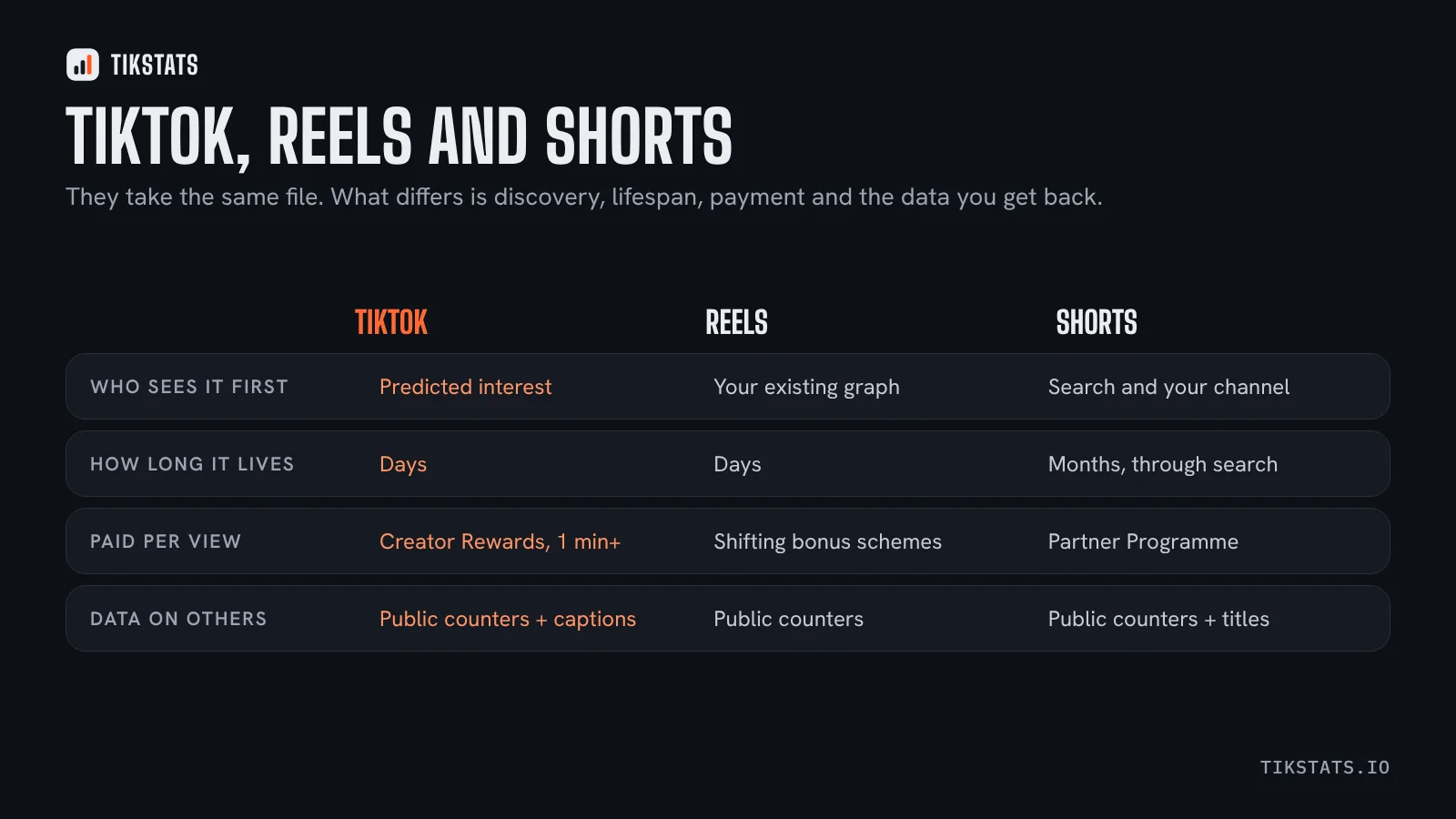
TikTok's For You feed is built from predicted interest rather than from who you follow, which is why a new account can reach a large audience and an established one can flop. This article goes through what TikTok says about those signals.
Reels leans more on your existing graph and on what Instagram knows about your connections. Shorts sits inside YouTube, where search and the recommendation engine around your channel both matter, and where a video can keep being found months later.
Practical consequence: a video that depends on being discovered cold belongs on TikTok first. A video that answers a question people type belongs on YouTube.
Difference 2: how long it lives
A TikTok does most of its work in the first days. A Short can be found through search long after posting, because YouTube indexes titles, descriptions and transcripts.
That changes what is worth writing. On TikTok a caption is mostly for context; on YouTube it is an entry point. If you repost there, write a real description instead of copying the TikTok caption, which this article covers.
Difference 3: how you get paid
TikTok pays views through the Creator Rewards Program, on videos over one minute, for accounts that qualify, at a rate the company does not publish. This article goes through what creators report.
YouTube pays Shorts through its Partner Programme, with its own thresholds, and pays long-form video far better per view than any short-form product. Instagram has moved between several bonus schemes rather than a stable per-view payment.
For most creators, none of the three is the main income. Brand deals, affiliate links and selling something of your own are, which is why engagement quality matters more than raw reach.
Difference 4: what data you get back
TikTok Studio gives you watch time, completion, traffic sources and follower activity for your own account. YouTube Studio gives you the same kind of depth plus search terms, which is genuinely useful. Instagram sits behind both.
For anyone else's content, all three limit you to public numbers. On TikTok that means views, likes, comments, shares, favourites, and the automatic captions when they exist, which this article details.
This is one place where TikTok is unusually generous: the spoken text of a video is public. That is why studying competitors' scripts is practical on TikTok and awkward elsewhere. This article uses it.
A reasonable way to use all three
- Make for TikTok first if discovery matters: it is the easiest place to be found by people who do not know you.
- Adapt rather than repost: new hook, real description, subtitles burned in cleanly rather than a watermark.
- Measure each with its own tools, and compare videos by speed in the first day rather than by final counts, which this article explains.
- Pick one platform to be good at. Three mediocre presences lose to one strong one.
Get a video's text to adapt it
Frequently asked questions
Which platform is best for a new creator?
TikTok is usually the easiest place to be found by people who do not follow you, because the For You feed is built from predicted interest rather than from your existing audience.
Can I post the same video on all three?
You can, but a watermark or a hook written for one feed works against you on the others. Adapt the opening and write a real description for YouTube.
Which pays best per view?
None of them pays well per view. Short-form payment schemes are small compared with brand deals, affiliate income or selling something of your own.